What does 忍 mean in this reading?
Japanese source · 初見良昭『戦国忍法図鑑』 · 3
自分の自我をおさえて行動しろというのが、忍法の忍の字の本当の意味である。
Translation : “The true meaning of the character 忍 in Ninpō is to act while keeping one’s own ego in check.”
Interpretation : The expression “true meaning” belongs to the author’s argument. We read it as a martial and moral instruction: do not let self-assertion determine a decision. It does not exhaust all linguistic meanings of 忍.
Japanese source · 初見良昭『戦国忍法図鑑』 · 3
自分のあらあらしい心の上に刃をあてて、たえまなく警戒して、心を忍ばせるのが、忍びである。
Translation : “To place a blade above one’s unruly heart, remain constantly vigilant and keep the heart restrained: that is shinobi.”
Interpretation : The visual pairing of 刃, blade, and 心, heart-mind, serves as a metaphor for vigilance. This is a symbolic teaching interpretation of the character, not a palaeographic or etymological demonstration.
Restraint, rationality and 礼節: how can they be practised?
The final passage of excerpt 3 connects Ninpō with rationality and 礼節 (reisetsu), respectful conduct in relationships. It asserts that such conduct already existed in the late Sengoku period. Without dated evidence in the excerpt, we retain its ethical ideal without treating that chronology as an established historical finding.
At the dojo, the application is observable: listening to an instruction, noticing tension, acknowledging an error and abandoning an unnecessary action. Calm does not remove martial commitment. It helps determine when to move, what distance to maintain and when to stop. Self-mastery thus gives technical work direction.
How are Ninjutsu and Shugendō related?
修験道 (Shugendō) is a Japanese religious tradition of mountain ascetic practice associated with 山伏 (yamabushi). Its religious context matters: reducing it to an old form of survival training would erase that meaning. Gyōja (行者) denotes an ascetic practitioner, not a synonym for ninja.
Japanese source · 初見良昭『戦国忍法図鑑』 · 2
忍術が修験と非常に密接な関係がある
Translation : “Ninjutsu has an extremely close relationship with shugen.”
Interpretation : A fragment of a longer sentence introducing an example. The author proposes a close connection; the excerpt does not demonstrate a single religious origin for Ninjutsu.
Japanese source · 初見良昭『戦国忍法図鑑』 · 3
山伏と忍者は紙一重の存在である。
Translation : “Yamabushi and ninja are separated, so to speak, by the thickness of a sheet of paper.”
Interpretation : This comparison belongs to the source. Mobility, knowledge of terrain and contact networks may be compared without conflating identities. Not all ninja were yamabushi, and not all yamabushi were ninja.
Katsuragi, En no Gyōja and Kusunoki: what can be concluded?
Katsuragi Shugen is associated with En no Gyōja (役行者) in the religious traditions presented by Japan Heritage. This provides a context of mountain practice, not evidence of transmission to a Ninjutsu school. Narratives concerning En no Gyōja must themselves be distinguished from historical attestations.
Excerpts 2 and 3 connect Kusunoki Masashige with Katsuragi, Iga and Momochi. They describe Akasaka and Chihaya through defensive use of terrain, hot water, stones and timber. These methods can inform a reading of asymmetric defence; they do not establish a ninja lineage or kinship with the Momochi.
We do not adopt as facts the extraordinary abilities attributed to ascetics in excerpt 2 or the blanket claim that Iga had no shugen sites in excerpt 3. These statements require independent investigation and are not needed for the martial teaching offered here.
How does this relate to Togakure Ryū Ninpō today?
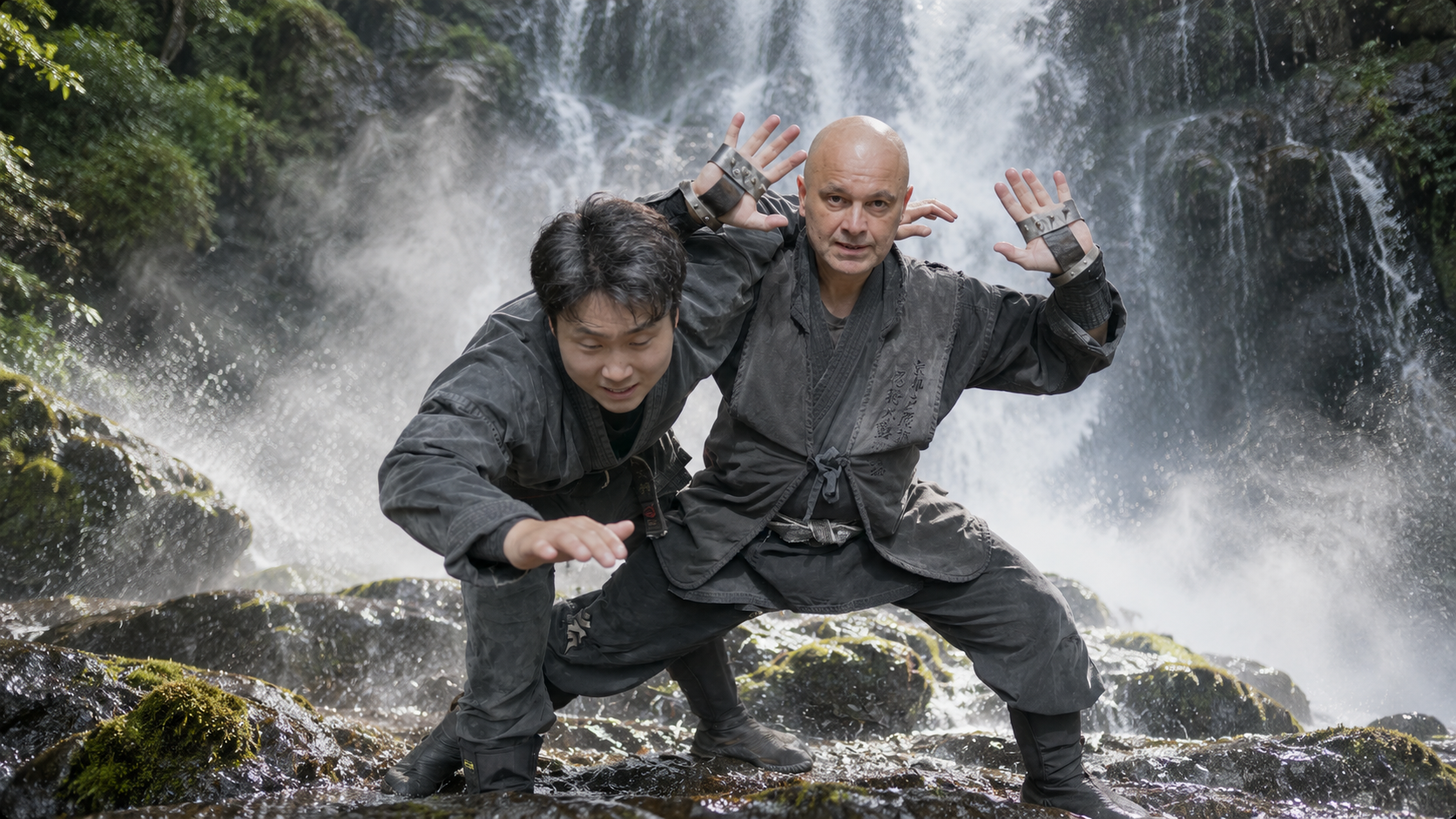
Our present-day reading connects restraint with movement, observation with terrain and respect with training alongside others. It does not turn the excerpts into proof of Togakure Ryū’s particular history. Jérôme Pailliette, practising since 1988, studying in Japan since 1999 and teaching in Kyoto since 2006, provides a context of experience and transmission, not a guarantee of historical truth.
Return to the Togakure Ryū Ninpō overview · Compare Ninjutsu and Ninpō · Explore the curriculum
Sources and historical notes
The three excerpts studied come from 初見良昭『戦国忍法図鑑』 — Sengoku Ninpō Zukan, by Masaaki Hatsumi, supervised by 樋口清之 (Kiyoyuki Higuchi), published by 新人物往来社 (Shin Jinbutsu Ōraisha). The National Diet Library catalogue confirms these responsibilities and publication in April 1978. This is a modern source of interpretation and transmission, not a document from the Sengoku period. The supplied photographs are identified as excerpts 1, 2 and 3; only page number 6 is visible on the first. The remaining page numbers and the precise printing of the photographed copy still need confirmation. French and English translations were prepared for this reading.
Bibliographical record — National Diet Library
- Documented history: what an identified source specifically supports.
- Traditional accounts: origin and lineage narratives reported as such.
- Author interpretation: analogies, hypotheses and judgements in the excerpts.
- Modern interpretation: teaching applications at the dojo, distinct from historical evidence.
Requires further historical verification: any medieval attribution not independently documented here. Editorial supervision of the book does not, by itself, corroborate every assertion it contains.
Japan Heritage — Katsuragi Shugen foundations — Katsuragi’s religious context and traditions concerning En no Gyōja. This source does not prove a lineage connecting Shugendō and Togakure Ryū.