
Jerome Pailliette
Jerome Pailliette
Ninjutsu Kyoto Togakure Ryu Ninpo Dojo | Instructor
My martial arts journey began at eight with Shotokan Karate, which I practised for approximately six years. In 1988, I began studying Ninjutsu. Over time, that search broadened into Ninpō: a way of developing the body, perception and the ability to adapt.
From 1999, I continued my study in Japan under Hatsumi Masaaki. Having settled in Kyoto in 2006, I continue practising, researching and teaching Togakure Ryū Ninpō here. For me, this remains a process of learning, shaped by experience and by the responsibility of passing on what I study.
Background
A Life of Martial Practice

- Childhood
First Steps in Martial Arts
Six years of Shotokan Karate from the age of eight established a foundation in posture, respect, repetition and physical training.
- 1988
Beginning Ninjutsu
Began studying and practising Ninjutsu, with an ongoing focus on Taijutsu, weapons, distance and adaptation.
- 1999
Training in Japan
Studied with Hatsumi Masaaki in Japan, deepening an understanding of the body movement and Ninpo principles behind the techniques.
- 2006
Practising and Teaching in Kyoto
Moved to Kyoto and continued practising and teaching Togakure Ryu Ninpo in a natural setting.
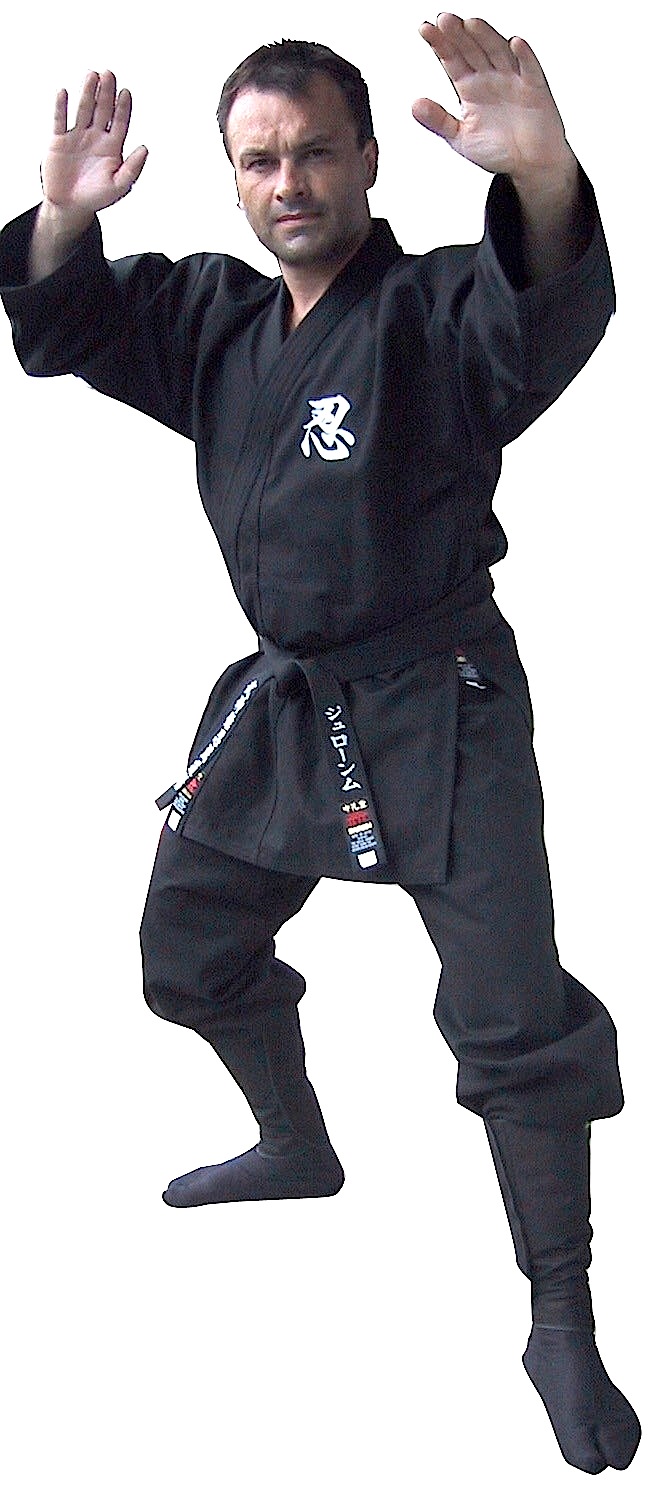
Jerome Pailliette in 2006, at the beginning of his teaching in Kyoto. Photograph supplied by the instructor.
From childhood imagination to lived practice
As a child, I was fascinated by the image of the ninja. I imagined someone able to face danger, find a way through difficult circumstances and survive through exceptional physical, mental and strategic abilities. This was a child’s perspective. Training gradually gave that fascination a more realistic and human dimension.
I was looking for more than a collection of fighting techniques. I wanted to explore a path bringing together body and mind, strategy, perception, self-control and the ability to protect. My understanding of Ninjutsu gradually widened into Ninpō through study and through encounters with my own limitations.
After searching and studying with different teachers in France, I felt a need to continue in Japan. From 1999, studying under Hatsumi Masaaki brought me into contact with a martial transmission associated particularly with Togakure Ryū Ninpō. This is my personal account of that experience, rather than a historical claim about the tradition.
The techniques I had initially sought opened up wider questions: how do we perceive distance, recognise danger, understand movement and remain adaptable? Since settling in Kyoto in 2006, these questions have continued to shape my training, personal research and teaching.
A personal path beyond technique
My personal path also includes an interest in and study of Shingon Mikkyō (真言密教) and Shugendō (修験道). These offer ways to reflect on discipline, perseverance, inner change and our relationship with nature. Impermanence, compassion and humility encourage me to look beyond technical effectiveness alone.
These are personal influences. They do not form an official curriculum of Togakure Ryū Ninpō and are not taught at the dōjō as compulsory elements of Ninjutsu. In my practice of Budō, they primarily inform self-control and consideration for how my actions affect others.
Teaching Approach
Keeping practice responsive and alive
Today, I emphasise natural movement and adaptation rather than a contest of force. Timing, distance, balance and an understanding of the body become meaningful through observation of the partner, the terrain and the situation. Awareness of danger and self-control require attention that extends beyond the shape of a technique.
Fundamentals are essential: they provide reference points and help us learn precisely. Their purpose, however, is not merely to repeat movements mechanically on a stationary or consistently cooperative partner. Study should gradually develop the ability to respond to changing, unpredictable conditions, within training that respects safety and each person’s capabilities.
Understanding grows through experience, adjustment and continued practice. It requires honesty about what we know, what remains uncertain and what still needs to be tested through training.

Teaching Togakure Ryu Ninpo in Kyoto
Nature is a teacher that leaves no room to disguise how you move.
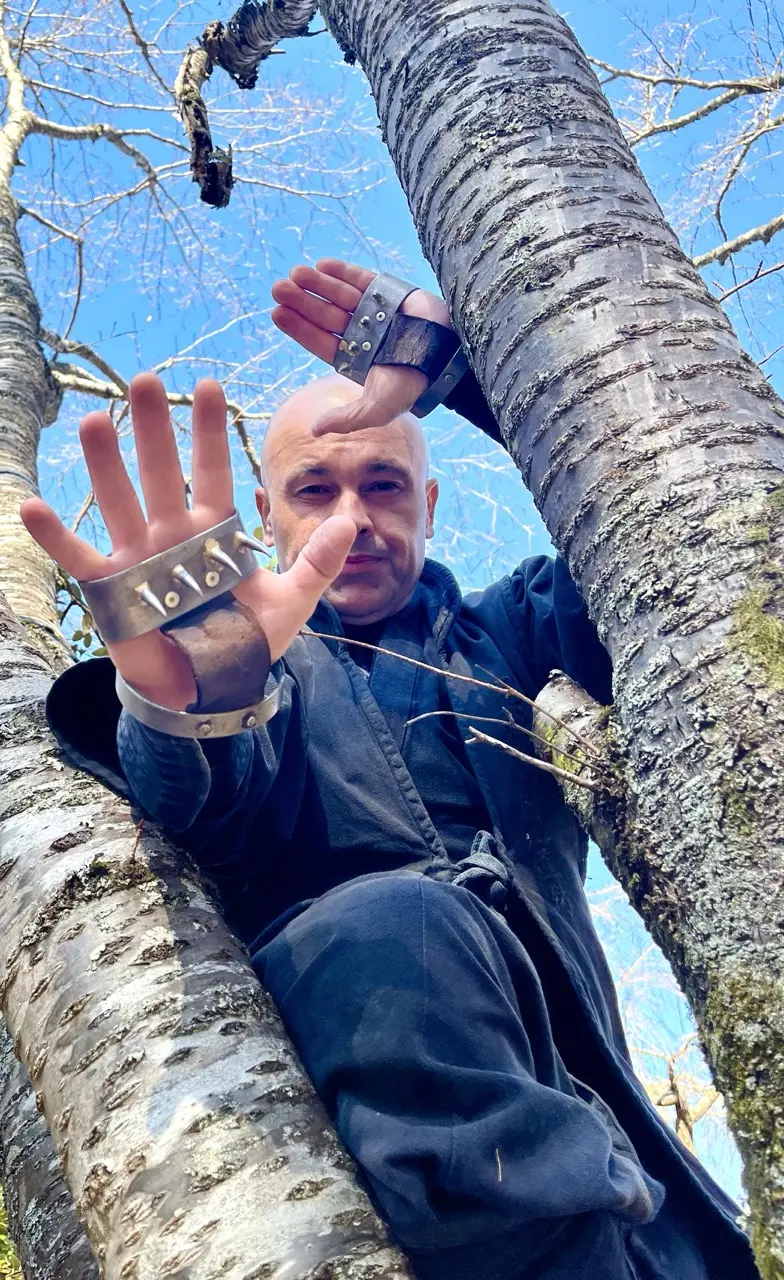
On Sakura no Mori’s uneven ground, you must remain aware of your footing, distance, surrounding people and trees. Instruction starts safely with fundamentals adapted to each person’s body and experience. The aim is to develop awareness, adaptability and the ability to protect yourself and preserve life.
Instruction is available in Japanese, English and French. Activities in Kyoto have also been featured by Kyoto Shimbun, Sankei Shimbun and Kansai TV’s “Yo–i Don!”.
I do not see practice as a pursuit of titles, rank, status or recognition. Experience, humility and continuity matter more. Teaching carries a responsibility towards students: to offer useful guidance, remain attentive to their development and continue learning myself.
“Continue. Endure. Protect. And pass it on.”