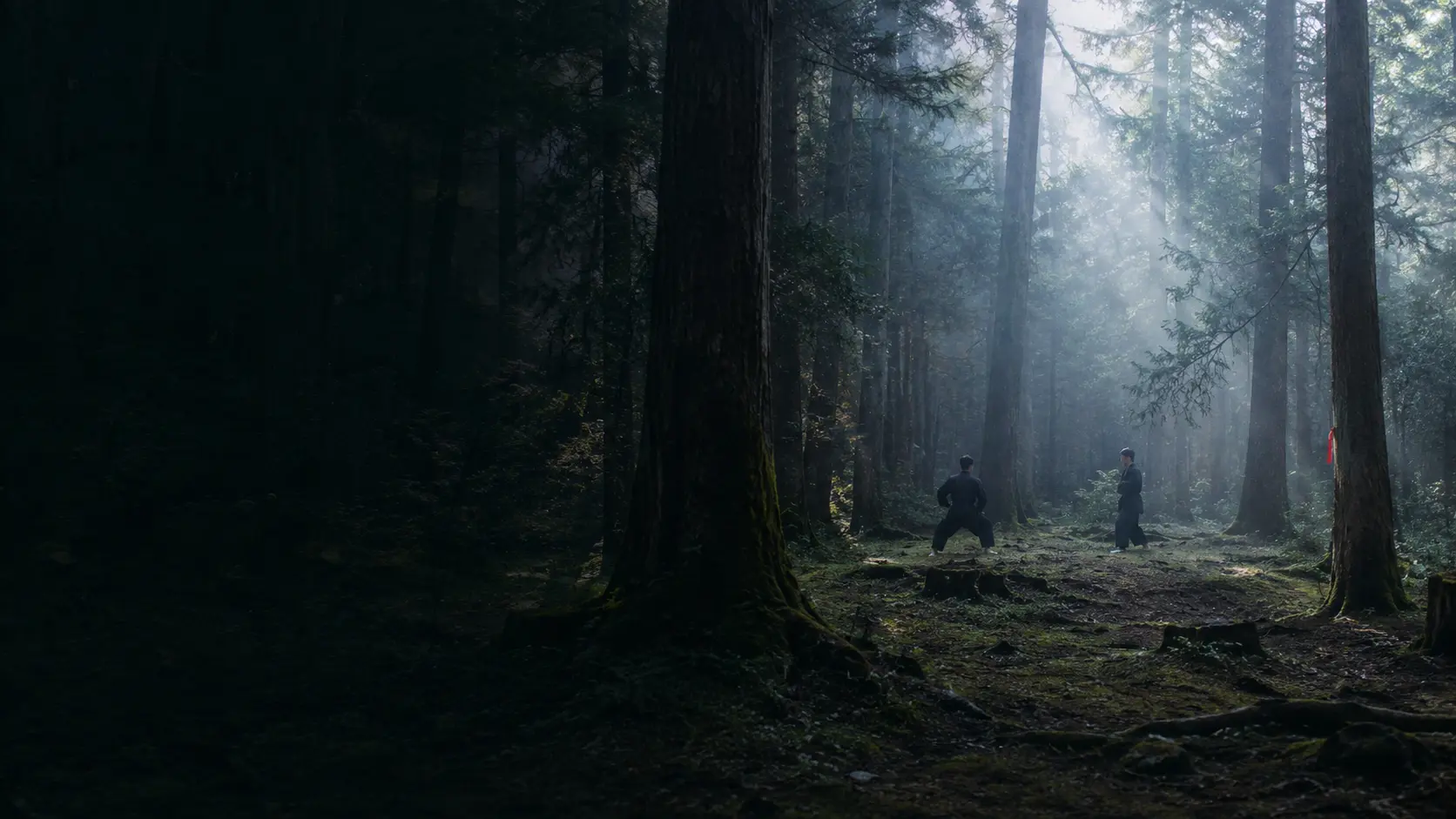

Togakure Ryu Ninpo training at Sakura no Mori in Kyoto’s Takaragaike Park

FREQUENTLY ASKED QUESTIONS

Understanding Our Approach to Ninpō

Find answers to frequently asked questions about Ninjutsu, Togakure Ryū Ninpō, our martial transmission, philosophy and values, and taking part in training in Kyoto.

Whether you are a beginner, an experienced practitioner or simply curious about the nature of Ninpō, this FAQ will help you understand our approach, our teaching and what defines Ninjutsu Kyoto.

NINJUTSU KYOTO

The Foundations of Our Approach

These seven pillars express Ninjutsu Kyoto’s own teaching and philosophical principles. They are not presented as seven historical precepts officially drawn from Togakure Ryū Denshō.

伝承Denshō
Transmission rather than invention
修行Shūgyō
Practice rather than appearance
実践Jissen
Experience rather than pretension
探究Tankyū
Depth rather than accumulation
謙虚Kenkyo
Humility rather than prestige
自立Jiritsu
Autonomy rather than dependence
忍法Ninpō
Preserving life and developing human potential

“Authenticity should not merely be claimed. It should be demonstrated.”

Understanding Ninjutsu and Ninpō

What is Togakure Ryu Ninpo?

Togakure Ryu Ninpo is a traditional practice that emphasises survival, self-protection, adaptation, awareness and mobility.

Rather than simply collecting techniques, we study body, mind, distance and natural surroundings as a whole. Training develops the judgement and movement needed to recognise danger, avoid conflict and protect yourself when necessary.

What is the difference between Ninjutsu and Ninpo?

Ninjutsu refers to practical techniques; Ninpo includes the principles and way of life that guide their use.

Ninjutsu includes body movement, mobility, self-protection and weapons skills. Ninpo develops patience, composure, insight and adaptability, addressing when, why and how to use those skills. The two belong together.

Is traditional Ninjutsu still practised in Japan?

Yes. Our dojo practises Togakure Ryu Ninpo in Kyoto.

At Sakura no Mori in Takaragaike Park, we study body movement, distance, Ukemi, weapons and adaptation to nature. Beginners are welcome.

Back to topics

Authenticity and Transmission

Do you teach authentic traditional Ninjutsu in Kyoto?

Yes. Ninjutsu Kyoto is a dojo dedicated to studying, practising and transmitting Togakure Ryū Ninpō (戸隠流忍法), continuing the teaching passed on by Hatsumi Masaaki (初見良昭).

Our approach brings together technical fundamentals, strategic principles, philosophy and the cultural and spiritual dimensions of Ninpō.

Rather than portraying a ninja character or focusing on appearances, we practise a martial art that develops practical abilities and a deeper understanding of the teaching.

How can I recognise authentic Ninjutsu teaching?

Authenticity cannot be judged solely by diplomas, belt colour, an instructor’s reputation or membership of an organisation.

It depends, among other things, on transparency about transmission, coherent knowledge, the quality of practice, fidelity to the principles taught and the ability to pass them on responsibly.

At Ninjutsu Kyoto, we value understanding, experience and putting Ninpō principles into practice more than outward signs of recognition.

What is the martial lineage of Ninjutsu Kyoto’s instructor?

Jérôme Pailliette has practised Ninjutsu since 1989. For several decades, he has continued studying Togakure Ryū Ninpō through the teaching of Hatsumi Masaaki, who inherited the transmission of Takamatsu Toshitsugu (高松寿嗣).

Based in Kyoto since 2006, he devotes his personal practice and teaching to deepening and transmitting Ninpō.

His background is presented openly in the instructor section of this website.

Back to topics

Bujinkan and Other Schools

How is this different from ninja in films and anime?

Our dojo practises Ninpo rooted in tradition, rather than performance or cosplay.

We study posture, movement, observation, self-protection, weapons, patience and adaptation through consistent practice. The purpose is to connect Ninpo with the real body and everyday life, not spectacular displays or fictional abilities.

Is Ninjutsu Kyoto part of the Bujinkan?

Ninjutsu Kyoto’s teaching has its roots in the transmission of Hatsumi Masaaki, founder of the Bujinkan (武神館).

Today, however, Ninjutsu Kyoto follows an independent path, primarily devoted to studying and deepening Togakure Ryū Ninpō.

This independence does not reject the teaching received. It is a choice that gives priority to practice, research, transmission and fidelity to the principles studied.

How does Ninjutsu Kyoto differ from other Ninjutsu schools?

Each school and organisation has its own history, teaching methods, aims and interpretation of martial transmission.

Ninjutsu Kyoto is distinguished by its specialisation in Togakure Ryū Ninpō, its independent approach, regular practice in nature and its attention to practitioners’ technical, mental and spiritual development.

Our aim is not to claim superiority over other schools, but to maintain the coherence and depth of our own approach.

Do you practise all nine martial schools of the Bujinkan?

Ninjutsu Kyoto focuses its teaching primarily on Togakure Ryū Ninpō.

Knowledge gained through the instructor’s martial background and the fundamentals of the Ten Chi Jin Ryaku no Maki can contribute to understanding this teaching.

Our purpose, however, is not to reproduce the entire curriculum of the nine martial traditions associated with the Bujinkan, but to explore the principles central to our approach in depth.

How does Ninjutsu Kyoto differ from a tourist ninja experience?

A tourist attraction can offer an enjoyable introduction to the world of ninjas, their history or their cultural representation.

Ninjutsu Kyoto offers a different experience: taking part in actual martial training alongside practitioners, under the guidance of an experienced instructor.

Visitors do more than play the role of a ninja. They encounter the principles, demands and practical reality of Ninpō training.

Back to topics

Philosophy and Values

What is Ninjutsu Kyoto’s philosophy?

Our philosophy rests on three guiding principles: protect, learn and transmit.

Ninpō practice develops physical, mental and human abilities that support the preservation of life, adaptability, discernment and autonomy.

For us, martial art is not a means of domination or self-aggrandisement, but a path of learning and personal transformation.

How important are belts and ranks in your teaching?

A rank can mark a stage in a martial journey, but it does not necessarily demonstrate actual mastery of an art.

At Ninjutsu Kyoto, we place greater importance on understanding principles, the quality of practice, individual progress and a practitioner’s conduct.

External recognition should never become the main purpose of training.

A practitioner’s worth is expressed through ability, judgement and actions far more than through a title.

What is your aim as a Ninpō instructor?

My aim is to deepen and embody Ninpō through my own practice, then transmit it faithfully and clearly so that my students can develop their abilities, discernment and autonomy.

The purpose is not to create dependence on an instructor, but to help each practitioner gradually build their own understanding of the teaching.

Why have you chosen to teach independently?

Independence allows us to devote more attention to practice, research, the study of principles and their transmission.

It also allows us to pursue martial study without making hierarchical advancement, institutional recognition or titles its ultimate purpose.

Our approach remains grounded in respect for the teaching received and responsibility for passing it on.

Is Ninpō a commercial activity?

Training fees contribute to the running of the dojo, the time devoted to teaching and the transmission of knowledge.

However, commercial profitability, selling ranks or continually seeking new members are not the purpose of Ninjutsu Kyoto.

We prioritise the quality of teaching, sincere commitment and practitioners’ progress.

Do I need to become a ninja to practise Ninpō?

No. Ninpō is not about adopting a ninja identity, appearance or character.

In contemporary life, its practice can develop observation, adaptability, self-control, the ability to face difficulties and the protection of one’s own integrity.

Rather than trying to become someone else, practitioners learn to understand themselves and develop their own abilities.

Why do you practise Ninjutsu outdoors?

Nature provides a living, constantly changing learning environment.

The landscape, trees, seasons, weather and varied terrain engage our observation, balance, movement and adaptability.

At Sakura no Mori (桜の森) in Kyoto, nature is an integral part of how we learn, rather than simply a backdrop to our practice.

Is competition part of your teaching?

Our teaching is not directed towards sporting competition, medals or ranking practitioners against one another.

We emphasise individual abilities, cooperation, exploring situations, self-control and adaptability.

A practitioner’s main challenge is to work beyond their own limitations, rather than seek superiority over others.

Back to topics

Spiritual Aspects

Does Togakure Ryū Ninpō have a spiritual dimension?

In our approach, Togakure Ryū Ninpō involves more than learning martial techniques.

Studying Ninpō also gives a place to self-control, concentration, perception, our relationship with the environment and understanding the mind.

Our enquiry includes the Japanese traditions of Mikkyō (密教) and Shugendō (修験道), and their cultural and spiritual connections with the world of Ninpō.

Do I need to be Buddhist to practise Ninpō?

No. Religious affiliation or adherence to a particular belief is not a condition of participation.

The philosophical and spiritual dimensions we study can be approached culturally, personally or contemplatively, with respect for everyone’s convictions.

Freedom of conscience and individual discernment are essential to our teaching.

Do you teach Kuji In and Kuji Kiri?

Kuji In (九字印) and Kuji Kiri (九字切り) are among the subjects we study in our research into the traditional and spiritual dimensions of Ninpō.

These practices need to be understood in their cultural and ritual contexts, including their relationship with certain traditions of Japanese esoteric Buddhism and Shugendō.

They are not presented as supernatural powers or magical techniques for becoming a ninja.

Their study calls for discernment, respect and an understanding of the context in which they are transmitted.

Back to topics

Training and Progression

Do you practise weapons?

Yes, weapons training is included with appropriate safety precautions.

We study the sword, hanbo, bo and shuriken progressively, according to experience and the session’s focus. Weapons help us understand distance, angle and body movement shared with unarmed Taijutsu.

Is Togakure Ryu Ninpo practical?

Training emphasises the judgement and movement needed to adapt to real danger.

Rather than meeting an attack with force, we read its line, distance, angle and terrain, prioritising protection and escape. Practice develops adaptability to different attacks and surroundings while maintaining safety.

How do practitioners progress in your teaching?

Progress draws on the fundamentals of the Ten Chi Jin Ryaku no Maki (天地人略の巻), the principles of Ninpō Taijutsu and their gradual application in practice.

Movement, postures, breakfalls, distance, balance, perception and adaptability are essential elements of this learning.

We favour understanding principles over mechanically collecting techniques.

Each practitioner progresses according to their experience, abilities and personal commitment.

How long does it take to master Ninpō?

Ninpō is a path of learning with no final endpoint.

Some fundamental knowledge and abilities can be acquired in the first months or years. Deep understanding, however, requires regular, sustained practice.

Even after several decades of training, a practitioner continues to learn, question their knowledge and refine their understanding.

Mastery is not a destination, but an ongoing process.

What do you expect of people who want to become your students?

We do not expect exceptional abilities, previous martial arts experience or perfect physical fitness.

Above all, we ask for sincerity, respect, humility, curiosity and a genuine willingness to learn.

Ninpō is not acquired simply by owning a uniform, a diploma or a collection of techniques. It develops through experience, regular practice, observation and working on oneself.

Our aim is to help practitioners understand, experiment and develop autonomy, rather than simply imitate.

Back to topics

Your First Training Session

Can beginners join the training?

Yes, beginners are welcome.

No martial arts experience is required. We begin with posture, breathing, Ukemi and footwork, progressing safely according to your experience and physical condition.

Can foreigners participate?

Yes, people of all nationalities can participate.

We welcome anyone willing to respect dojo etiquette, safety instructions, the training location and fellow participants. Kyoto residents and visitors should contact us in advance with their preferred date.

Do I need to speak Japanese?

No, you can participate without speaking Japanese.

Instruction is available in Japanese, English and French. Please tell us your preferred language when you enquire.

What age can children start?

There is a Ninja Kids class for children aged 9–12.

Participation in group training and classes for teenagers aged 12–18 is arranged individually, taking safety and physical development into account. Please contact us with your child’s age and experience.

What should I wear?

Wear comfortable clothes that can get dirty, with trainers suitable for outdoor activity.

You do not need to buy a uniform or weapons for your first session. Bring water and prepare for the season, including cold, heat or rain as appropriate.

Do I need previous martial arts experience?

No previous martial arts experience is required.

Experienced practitioners explore Togakure Ryu Ninpo principles while drawing on their existing movement skills. Beginners receive careful guidance in posture, breathing, balance and Ukemi.

Back to topics

Practical Information

Where do you train in Kyoto?

We train at Sakura no Mori in Kyoto’s Takaragaike Park.

The nearest station is Kokusaikaikan on the Kyoto Subway Karasuma Line, approximately five minutes away on foot. First-time participants receive the precise meeting point once attendance is confirmed.

Do you train when it rains?

Heavy rain or severe weather may lead to a change or cancellation.

We assess the weather and ground conditions before deciding and notify participants in advance. In light rain, please still dress appropriately for the conditions.

Can I observe a class?

Please contact us in advance if you would like to observe.

As training takes place in a public park, we arrange observation with participants’ safety and concentration in mind. Trial training costs ¥1,900; please tell us your preferred date in advance.

Is private training available?

Yes, private training can be tailored to your goals and experience.

Private training costs ¥3,800 for one hour or ¥6,800 for two hours, with additional hour packages for ongoing study. Contact us with your goals, preferred date and experience.

How much does training cost?

Group training costs ¥2,900 for two hours.

Classes run every Sunday from 10:00 to 12:00. Trial training is ¥1,900. See Fees & Participation for children’s classes and private training.

Back to topics

From Understanding to Practice

Understanding Ninpō involves more than reading or acquiring theoretical knowledge. It develops through experience, observation and practice.

If you would like to discover our teaching of Togakure Ryū Ninpō, we invite you to join us at Sakura no Mori, in the heart of Kyoto’s natural surroundings.

Your Next Step

Have another question?

Get in touch about dates, private training, observing a class or anything else you would like to know.

Contact