
Jérôme Pailliette — Ninjutsu Kyoto · 京都
I began martial arts because I needed to protect myself. Over time, Ninpō became a path of practice, discernment, and transmission. This is my experience, not a claim that everyone must share my conclusions.
01 Learning to protect myself — the years of shadow
I grew up in Fontenay-sous-Bois, in the Val-de-Marne area outside Paris, in a public housing estate. Poverty, fear of assault, intimidation, and the risk of extortion were part of my everyday environment. My father was absent, and my mother raised my younger brother and me in difficult financial circumstances.
Unable to meet all our needs, our family went through a period that led to our placement under the care of the DDASS, the former French child welfare administration. We experienced mistreatment in foster care, a lack of parental affection and protection, and the pain of being separated. I want to acknowledge these experiences without exposing every private detail.
I felt a need to protect myself, endure, survive, and, as far as I could, protect my younger brother. At school, bullying and violence from classmates strengthened that need. At eight, I began karate, not in pursuit of titles or competition, but to learn how to defend myself.
None of those hardships was fair or necessary for my development. They nevertheless marked my character and strengthened my determination to believe that better days were possible. I did not yet know that the search for protection would open onto a broader path: learning how to live and, eventually, how to teach.
02 Seven years of karate and the discovery of Ninjutsu
I practiced karate for seven years, reaching brown-belt level. I no longer wanted to continue simply to prepare for a black-belt examination. The formalized techniques and competition rules I knew left me frustrated: I also wanted to understand gripping, controls, throws, and forms of movement that this framework restricted.
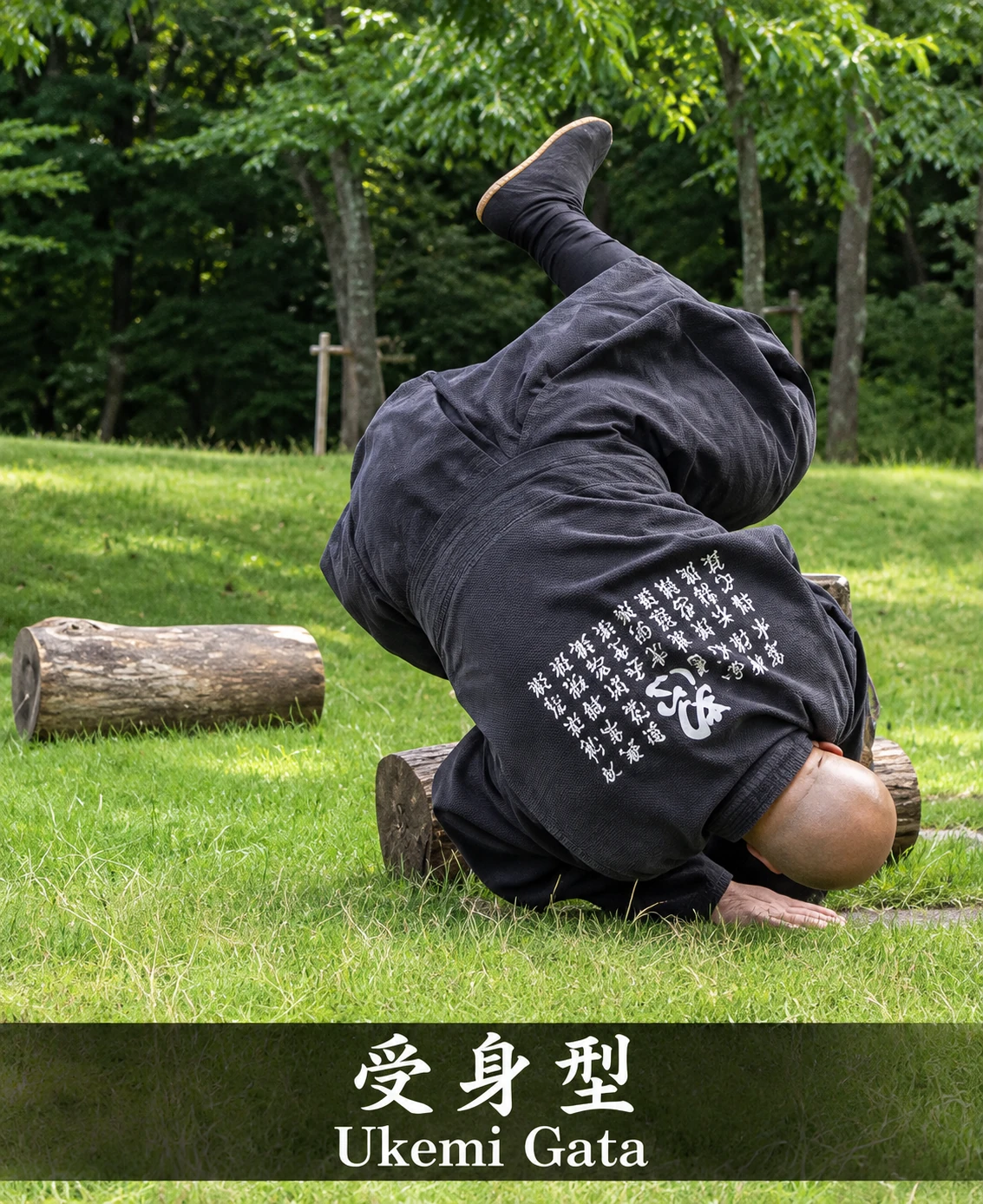
In 1988, I discovered the image of Ninjutsu and the art of the Ninja, especially through Shō Kosugi's action films. My first curiosity came from cinema, not from any deep knowledge of the tradition. Financial constraints meant that I had to wait until 1989 to begin actual Ninjutsu training under Sylvain Guintard, a student of Masaaki Hatsumi.
What drew me to his teaching was not only technical variety. Sylvain Guintard also practiced Shugendō and incorporated some of its elements into his personal approach. That spiritual dimension, which must be distinguished from the martial teachings I associate with Hatsumi Sensei, answered my wish to bring physical study and inner inquiry together.
03 Different teachers, and a dojo that became home
After Sylvain Guintard left for Japan in the early 1990s, I continued training for about two years with his student Arnaud Cousergue. I then completed one year of military service. On my return, Samir Saad had taken over, and I trained with him until 1998.
Samir Saad gave me an opportunity to teach Ninjutsu to children. At a time when I had nowhere to live, he also arranged for me to stay at the dojo, with the manager's permission. It was not only a training space but also a place to live and take responsibility. I remain grateful to him for those gestures.
His sudden departure for the United States in 1998 left us without our usual instructor. Across these changes, admiration for certain teachers was joined by questions about gaps I sometimes perceived between professed principles and everyday behavior. I became increasingly aware of the difference between appearing to be something and actually being it.
04 Seeking the source: Japan
I had long dreamed of finding an authentic master: someone whose practice, words, and actions were in harmony. I have sometimes wondered whether this longing was connected to my father's absence, without claiming that one fact explains my whole life. I also felt that my path would one day lead to Japan, a feeling strengthened by dreams and words that stayed with me. I describe these as personal experiences, not proven predictions.
In 1999, I made my first journey to Japan and met Masaaki Hatsumi Sensei. I did not yet speak Japanese fluently enough to explain my concerns to him directly. I returned in 2003 and again in 2004. During my 2003 visit, Hatsumi Sensei personally handed me my Japanese fourth-dan (四段) certificate. Both the year and the rank matter in my story.
Studying Japanese, speaking with Hatsumi Sensei, and reading Japanese texts gradually helped me better understand the nuances of the language and teachings. It was then that my desire to continue Ninpō became less dependent on any single teacher: I wanted to listen, observe, study, and test my understanding through practice.
In November 2006, I settled in Japan on a lasting basis. Kyoto became the place where I continue that search and have chosen to teach.
05 Ranks, the Sakki Test, and my personal choice
During my visits in 2003 and 2004, I watched Sakki Tests (殺気試験), the test associated with fifth dan in the Bujinkan. A candidate seated in seiza attempts to avoid a strike coming from behind. In some cases I observed, the award of rank seemed difficult to reconcile with the outcome as I saw it. These are my observations and judgments; I cannot know all the reasons behind the decisions, nor generalize about every candidate.
The Sakki Test is not designed as a complete technical examination. That was precisely my concern: in my view, the rank resulting from it should not be presented as proof of mastery of all the fundamentals. I also questioned how an examination could account for integrity and responsibility, qualities that cannot be inferred from a single moment.
After moving to Japan, I was offered the opportunity to take the fifth-dan Sakki Test. I chose not to take it. That decision reflected my convictions: I did not want to pursue a title I did not regard as a sufficient measure of technical competence, discernment, or inner awakening.
I sometimes encountered instructors whose claims, ranks, or titles seemed out of step with the abilities they demonstrated. Still, I do not reduce the whole Bujinkan to those experiences. I value knowledge I received while choosing a different relationship to institutional recognition.

06 Being rather than appearing: truth and sincerity
I aspire to truth, authenticity, and sincerity of heart. Rank can serve an educational or organizational purpose; it cannot replace practice or knowledge earned through effort. The complexity of Ninjutsu — movement, distance, adaptation, observation, environment, confrontation, and self-control — seems too vast to be expressed fully by a ladder of ranks.
Miyamoto Musashi's journey inspires my reflections on personal martial study. I do not claim to resemble him: his example simply reminds me to prefer sustained practice over the pursuit of glory. I want to train every day without making honors or the opinions of others a measure of my worth.
In my understanding of the Shinobi, one does not need a prestigious name, a title, or social position. What matters is to keep learning and to strive for consistency between words and actions. What we are matters more than what we claim to be.
07 Ninpō, spirituality, and ikigai
My faith in Shingon Esoteric Buddhism (真言密教), my devotion to Dainichi Nyorai (大日如来), and my interest in Shugendō accompany my journey. I distinguish these personal spiritual commitments from the technical and historical teachings of Togakure Ryū Ninpō; it would be inaccurate to present them as one single doctrine.
I seek a deeper understanding of myself, of what I call my higher self. I make no claim to enlightenment. For me, a path of martial awakening means continuously cultivating awareness, clarity, self-control, and responsibility.
Ninpō has become an essential part of my ikigai (生き甲斐), what gives meaning to my life. The child who was trying to survive could not have known that he would one day devote his life to practicing, learning, and transmitting. From shadow to light does not mean erasing the past: it means continuing despite it and trying to turn experience into responsibility.

08 Preserving and teaching in Kyoto
In my experience, Togakure Ryū Ninpō offers a remarkable range of principles and subjects that I can study every day. I see it as an authentic tradition in my own understanding, one I wish to preserve and transmit. This is my conviction as a practitioner, not proof that no other Ninjutsu tradition can be authentic. Rigor requires distinguishing documented history, received traditions, and personal interpretations.
In Kyoto, I teach with an emphasis on movement fundamentals, practical training, adaptability, and discernment. I want students to develop their own abilities rather than admire a rank or repeat claims. Teaching, to me, also means acknowledging what I do not yet know.
I address those who, like me, seek truth, sincerity of heart, and a sense of justice. I do not wish to dictate what others should believe or label them ignorant: I want to give them ways to observe, question, and verify things for themselves.
Protect (守る). Learn (学ぶ). Transmit (伝える). That is the purpose of my approach. I continue my own shūgyō without claiming to possess the whole truth of Ninpō. What began as a need for protection has become, over the years, a way of living and a reason to share.
PROTECT · LEARN · TRANSMIT
Jérôme Pailliette | Ninjutsu Kyoto | Togakure Ryū Ninpō
